Not long ago, my guest,Tom Stroup talked about his involvement with the School Pride project. It debuts tomorrow night on NBC, and I encourage you to check your local listings, and if you can't watch, set your recorders. It's gratifying to see people giving back instead of taking for a change.
And, for more of my Emerald City recaps....

Welcome to Terry's Place. I'm an author of mystery and romance, happy to share what I'm learning, both about writing and anything I find interesting.
Thursday, October 14, 2010


Wednesday, October 13, 2010
Emerald City Part 1
Thanks to Gerrie for yesterday's post. Writing seems to be something inside us, and we're going to do it no matter what.
 After wrapping up notes from the Writers' Police Academy, it's time to plunge into recapping workshops from the Emerald City Conference. The first workshop I attended was about writing emotionally gripping scenes, given by Margie Lawson.
First, it's important to understand that we, as human beings, have involuntary responses to certain situations and stimuli. These are visceral responses, things we really can't control. In high-emotion situations, our hearts beat faster, mouths get dry, hands sweat, etc. These responses are tied to the body, not our conscious thought-processes.
When writing, especially in scenes with emotional impact, we should draw on these responses and make the reader feel them as well. We've all heard, "show, don't tell" and we probably know better than to say, "She was scared." Instead, we might say, "Her stomach clenched with fear." But is that enough?
 After wrapping up notes from the Writers' Police Academy, it's time to plunge into recapping workshops from the Emerald City Conference. The first workshop I attended was about writing emotionally gripping scenes, given by Margie Lawson.
First, it's important to understand that we, as human beings, have involuntary responses to certain situations and stimuli. These are visceral responses, things we really can't control. In high-emotion situations, our hearts beat faster, mouths get dry, hands sweat, etc. These responses are tied to the body, not our conscious thought-processes.
When writing, especially in scenes with emotional impact, we should draw on these responses and make the reader feel them as well. We've all heard, "show, don't tell" and we probably know better than to say, "She was scared." Instead, we might say, "Her stomach clenched with fear." But is that enough?
Tuesday, October 12, 2010
Words and Places
Today my guest is author Gerrie Ferris Finger. Unlike myself, she's always known she was going to be a writer. Welcome, Gerrie.
 I knew I wanted to be a writer by the time I read my first storybook. Words enthralled me and still hold that particular power. My fascination with stringing words together naturally grew into composing mysteries. I recall an early story about our barn door being left open and one of our horses getting out. Who had left it open and why? No one admitted doing it, so the silence grew into a more sinister saga. The horse was out all night and developed a cough, and I couldn’t ride in a show the next day. Evil forces at work; which opponent wanted me out of the ring?
More than one great novel has grown from a simple childhood tale like that. But when aspiring writers grow into maturity, they must deal with the trappings of character development, setting, plot, subplot, etc. and that’s when simple becomes complicated. E. M. Forster wrote: “The king died and then the queen died is a story. The king died and the queen died of grief is a plot. The queen died and no one knew why until they discovered it was of grief is a mystery, a form capable of high development.”
 I knew I wanted to be a writer by the time I read my first storybook. Words enthralled me and still hold that particular power. My fascination with stringing words together naturally grew into composing mysteries. I recall an early story about our barn door being left open and one of our horses getting out. Who had left it open and why? No one admitted doing it, so the silence grew into a more sinister saga. The horse was out all night and developed a cough, and I couldn’t ride in a show the next day. Evil forces at work; which opponent wanted me out of the ring?
More than one great novel has grown from a simple childhood tale like that. But when aspiring writers grow into maturity, they must deal with the trappings of character development, setting, plot, subplot, etc. and that’s when simple becomes complicated. E. M. Forster wrote: “The king died and then the queen died is a story. The king died and the queen died of grief is a plot. The queen died and no one knew why until they discovered it was of grief is a mystery, a form capable of high development.”
Monday, October 11, 2010
Writers' Police Academy, Part 5
What I'm reading: Crossfire, by Dick Francis and Felix Francis

Promo note – WHEN DANGER CALLS is now available at the Kindle Store. It's $2.99. Of course, if you want an autographed hard copy (great for gifts) you can still get them either through the regular Amazon store or via my website.
Back to the Writers' Police Academy
Dr. Jonathan Hayes was the featured afternoon speaker (again, right before dinner) and he elaborated on his earlier talk. This time, he focused on points which we authors can use to get things right in our books.
(Note: you might not want to be reading this over breakfast)

Promo note – WHEN DANGER CALLS is now available at the Kindle Store. It's $2.99. Of course, if you want an autographed hard copy (great for gifts) you can still get them either through the regular Amazon store or via my website.
Back to the Writers' Police Academy
Dr. Jonathan Hayes was the featured afternoon speaker (again, right before dinner) and he elaborated on his earlier talk. This time, he focused on points which we authors can use to get things right in our books.
(Note: you might not want to be reading this over breakfast)
Friday, October 08, 2010
Friday Field Trip - Fall in Florissant
While I was on the road, Hubster did a Sunday hike in Florissant again. I thought it would be interesting to compare the pictures we took at the end of August with what he saw last week. We definitely have seasons here!
These two were taken August 22nd.


Hornbeck Homestead, summer

Click to see what the area looked like last Sunday
These two were taken August 22nd.


Hornbeck Homestead, summer

Click to see what the area looked like last Sunday
Thursday, October 07, 2010
Writers' Police Academy, Part 4 - FATS
What I'm reading: Shoot to Thrill, by P.J. Tracy
A bonus guest this week. The Hubster is here recounting his adventures in the Firearms Simulation Training at the Writers' Police Academy.
The decision to sign up for Firearms Training Simulator (FATS) module at the Writers Police Academy (WPA) was virtually a “no brainer”. You handle guns and get a big adrenalin rush. However, as it turns out, not all FATS programs are the quite same.
My first experience with FATS was at the Orange County (Florida) Sheriff’s Office as a part of the Civilian Police Academy. The OCSO’s simulator was in a small room with the projection screen up front and a ‘shoot back’ function whereby the operator could shoot nylon balls at the trainee if she/he doesn’t seek cover at the appropriate time. The operator chose a ‘scenario’ for the trainee to experience and make appropriate decisions.
The trainee was equipped eye protection and with a Glock 9 mm that ‘fired’ individual cartridges that were mini compressed air cylinders. When fired, each cartridge generated recoil and was ejected. Ammunition was limited to the capacity of the magazine. I don’t remember what my scenario was but I do remember that my heart rate jumped while going through the scenario and wondering if and when I’d have to make a decision to shoot or not. I made a decision to shoot. The system tracks each shot fired and you can see how you did on playback. My wife wanted the operator to test the shoot-back function on me but he wisely declined. It was interesting to note how each student handled the Glock – where it was pointed and whether or not a finger was on the trigger at inappropriate times. A few folks were clearly in need of some serious handgun safety training.
A bonus guest this week. The Hubster is here recounting his adventures in the Firearms Simulation Training at the Writers' Police Academy.
The FATS Experience, by The First Victim
The decision to sign up for Firearms Training Simulator (FATS) module at the Writers Police Academy (WPA) was virtually a “no brainer”. You handle guns and get a big adrenalin rush. However, as it turns out, not all FATS programs are the quite same.
My first experience with FATS was at the Orange County (Florida) Sheriff’s Office as a part of the Civilian Police Academy. The OCSO’s simulator was in a small room with the projection screen up front and a ‘shoot back’ function whereby the operator could shoot nylon balls at the trainee if she/he doesn’t seek cover at the appropriate time. The operator chose a ‘scenario’ for the trainee to experience and make appropriate decisions.
The trainee was equipped eye protection and with a Glock 9 mm that ‘fired’ individual cartridges that were mini compressed air cylinders. When fired, each cartridge generated recoil and was ejected. Ammunition was limited to the capacity of the magazine. I don’t remember what my scenario was but I do remember that my heart rate jumped while going through the scenario and wondering if and when I’d have to make a decision to shoot or not. I made a decision to shoot. The system tracks each shot fired and you can see how you did on playback. My wife wanted the operator to test the shoot-back function on me but he wisely declined. It was interesting to note how each student handled the Glock – where it was pointed and whether or not a finger was on the trigger at inappropriate times. A few folks were clearly in need of some serious handgun safety training.
Wednesday, October 06, 2010
Writers' Police Academy, Part 3
I arrived home late enough last night to be brain dead after a full day of travel. I had written today's post on the road, and hope it's relatively coherent. Two conferences almost back-to-back are draining. I'll work my way through a few more WPA posts, then start on the Emerald City recaps. Stick around.
 The second day at the Writers' Police Academy got off with a bang. Literally. We were ushered into a hallway at the college, ostensibly to hear one of the deputies talk about law enforcement on campus. He was interrupted by one of the group, who began shouting about his grades, and that someone had cheated. (He was a plant, of course). The next thing we knew, shots were fired, and someone was on the floor, bleeding. The action moved down the hall to a classroom where we could hear more shouting and more gunshots. The deputy called campus police and the EMS team, and we watched as the paramedics attended to the victims, and the police ushered a classroom full of students outside, hands on their heads. Afterward, we were free to ask questions about what we'd seen and heard.
 The second day at the Writers' Police Academy got off with a bang. Literally. We were ushered into a hallway at the college, ostensibly to hear one of the deputies talk about law enforcement on campus. He was interrupted by one of the group, who began shouting about his grades, and that someone had cheated. (He was a plant, of course). The next thing we knew, shots were fired, and someone was on the floor, bleeding. The action moved down the hall to a classroom where we could hear more shouting and more gunshots. The deputy called campus police and the EMS team, and we watched as the paramedics attended to the victims, and the police ushered a classroom full of students outside, hands on their heads. Afterward, we were free to ask questions about what we'd seen and heard.
Tuesday, October 05, 2010
Culture Shock - American Style
I’m pleased to welcome Jenyfer Matthews to the blog today. Jenyfer is an American living in Cairo, Egypt who I met online when we were both published at Cerridwen Press, and I’ve enjoyed hearing about her life in Egypt and her travels on her blog. Today she’s here talking about culture shock, American-style.
People give me a lot of credit for living abroad and traveling as much as I do. Really and truly, while it is interesting and often fun, it’s not really that difficult.

Think about it: I am a blonde American woman living in the Middle East so I don’t blend in at all. No one expects me to know anything so they are inordinately thrilled when I can manage a few words of Arabic (or whatever language of the country I’m visiting) If I inadvertently overlook some local custom, no one expects any better of a know-nothing foreigner anyway. Truly, traveling in Asia and the Middle East is pretty easy – Europe is where I’ve had more trouble. I guess it’s all my Northern European heritage showing because no matter where I’ve gone, everyone has always seemed shocked to hear American accented English coming out of my mouth instead of the local language.
People give me a lot of credit for living abroad and traveling as much as I do. Really and truly, while it is interesting and often fun, it’s not really that difficult.
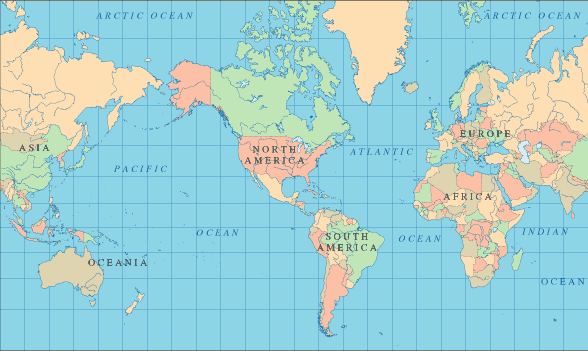
Think about it: I am a blonde American woman living in the Middle East so I don’t blend in at all. No one expects me to know anything so they are inordinately thrilled when I can manage a few words of Arabic (or whatever language of the country I’m visiting) If I inadvertently overlook some local custom, no one expects any better of a know-nothing foreigner anyway. Truly, traveling in Asia and the Middle East is pretty easy – Europe is where I’ve had more trouble. I guess it’s all my Northern European heritage showing because no matter where I’ve gone, everyone has always seemed shocked to hear American accented English coming out of my mouth instead of the local language.
Monday, October 04, 2010
Writers' Police Academy, Part 2
What I'm reading: White Heat, by Brenda Novak
Back to my notes from the Writers' Police Academy. The latter part of Friday was spent listening to Dr. Jonathan Hayes, Senior Medical Examiner for New York City. He began by explaining what a forensic pathologist is and does. Forensic pathology is a sub-specialty of pathology, and the major expertise is the evaluation of injuries. He also explained the difference between coroners and medical examiners, the former being elected officials who may or may not have any medical or forensic background. Medical examiners are not elected officials. The trend now is to move from coroners to medical examiners who are specialists in the examination of death, and are apolitical.
 To become a medical examiner, beyond the normal medical school, internship, and residency, one needs to deal with 250 autopsies, as many homicides as possible, as many crime scenes as possible, and then have lab experiences with DNA, blood spatter, criminalistics, and toxicology (and more).
Medical examiners, at least in New York, are part of the public health system, NOT law enforcement.
They must determine cause and manner of death, the cause of death being the disease or injury that leads to death. Manner of death explains how that death came about. There are only a limited number of them: Natural, Accident, Suicide, Homicide, Therapeutic Complication, and Undetermined.
Of the above, suicides require the highest degree of proof. And, contrary to what we see on television, only about 5% of deaths are ruled homicides.
Back to my notes from the Writers' Police Academy. The latter part of Friday was spent listening to Dr. Jonathan Hayes, Senior Medical Examiner for New York City. He began by explaining what a forensic pathologist is and does. Forensic pathology is a sub-specialty of pathology, and the major expertise is the evaluation of injuries. He also explained the difference between coroners and medical examiners, the former being elected officials who may or may not have any medical or forensic background. Medical examiners are not elected officials. The trend now is to move from coroners to medical examiners who are specialists in the examination of death, and are apolitical.
 To become a medical examiner, beyond the normal medical school, internship, and residency, one needs to deal with 250 autopsies, as many homicides as possible, as many crime scenes as possible, and then have lab experiences with DNA, blood spatter, criminalistics, and toxicology (and more).
Medical examiners, at least in New York, are part of the public health system, NOT law enforcement.
They must determine cause and manner of death, the cause of death being the disease or injury that leads to death. Manner of death explains how that death came about. There are only a limited number of them: Natural, Accident, Suicide, Homicide, Therapeutic Complication, and Undetermined.
Of the above, suicides require the highest degree of proof. And, contrary to what we see on television, only about 5% of deaths are ruled homicides.
Friday, October 01, 2010
Friday Field Trip - The Arizona Desert
Last week, Bill Penrose shared some wildflower pictures. This time, we're taking a look at the bigger picture.
Steep Descent To Warbonnet Ranch

Warbonnet Ranch

Steep Descent To Warbonnet Ranch

Warbonnet Ranch

Subscribe to:
Posts (Atom)