What I'm reading: Pride and Pleasure, by Sylvia Day.Yesterday, the contractor told us that he'd requested the final electrical inspection, which is independent of the final inspection. Given that there was, in my mind, still work to be done, I wondered if he was trying to move too fast. Sure enough, the inspector found four basic omissions which will have to be corrected. These seemed to be relatively obvious and simple things an electrician should know, but given that it's his job, and the job of the contractor to make sure everything meets code, I'm not going to fret. (After all, I'm the one holding the checkbook.) When we're writing, we have to make sure we conform to the "code" of our stories. Whether we're aware of them or not, we're making promises to the reader. Just like the electrician promises a safe house, an author promises the reader that everything in the story will hold together.I wrote the first scene of chapter 33 in my manuscript the other day, before getting "sidetracked" by digitizing things for All Romance eBooks. (Which, by the way, now includes 3 more choices.) With my WIP at a Word count of almost 98K, it's time to wrap things up. I realized the brick wall I thought I'd run into was only there because the book was technically over. The mystery/suspense threads had been resolved. My heroine was safe. This isn't a book with international bad guys who might show up at any time. It was time to resolve the romance threads and get the heck out.
Thanks to Molly for yesterday's post (even if my books didn't make her list!). There's some good reading material there.One of the first lessons I learned when writing was "Only Trouble is Interesting."Conflict doesn't have to be earth-shattering, in-your-face, knock down drag-em-out. In fact, sometimes the best conflicts are the everyday events. They may not be "exciting" in terms of things like car crashes or explosions, but readers can relate to them. And these sorts of things can keep the tension going in between the big stuff. And too much of that 'big stuff' can either exhaust the reader, or get boring.. Recently, All Romance eBooks opened its doors to individual publishers, so I decided that I'd upload my two books, What's in a Name? and When Danger Calls to their online store. I'd already uploaded them to the Kindle Store and Smashwords, so I figured it would be simple enough.Nope. First, there's no formatting provided. If you want to put your book on their site, you have to provide it in the formats they offer. Although I can handle PDF and HTML easily enough (those are simply "save as" options in Word), I was clueless about things like lit, PRC, mobi, and epub.
Molly MacRae’s short stories and novels are set in the foothills of the Blue Ridge Mountains, about as far north and east as you can get in Tennessee without being in either Virginia or North Carolina, where she lived for twenty years. Now she lives in central Illinois, a much flatter place, where she works at the public library connecting children with books. “What’s good?” I get that question a lot at the library. Sometimes I feel like a barmaid. A patron will walk up to lean against the counter. I smile, say hello, ask how I can help. The answer is often a variation of “What’s good?” “I’m looking for a good book.”“I liked the last book you recommended. What else have you got?” “So, what’ve you been reading lately?” I smile and serve up the latest and the best. I love the question, “what’s good?” Sometimes my mind goes blank and I have to give myself a shake to get it going again. It usually does get going again, though, and then I rub my hands together, practically smacking my lips with satisfaction, because I’ve got a reader on the hook; I’ve caught another one. But what does “what’s good?” have to do with writing? Everything. If you don’t read, read, read, how can you write? If you don’t ask “what’s good?” and then hunt that down and read it, then what are you doing?
What I'm reading: Unspeakable, by Laura GriffinThere's been a lot of discussion about going the indie route in some of the groups I belong to. One thing I've noticed is there are those who have trouble with what I consider Word formatting basics. Given that I started this business with an e-publisher, I learned how to deal with some basic formatting from the beginning.I thought I'd share a few of the tools anyone using Word should have, because while a manuscript might look right when it's printed, there are all sorts of little codes and formatting issues that will make a mess of things when it's re-formatted for the digital screen and the variety of e-readers out there.The first would be page setup. Click "File" then Page Setup. 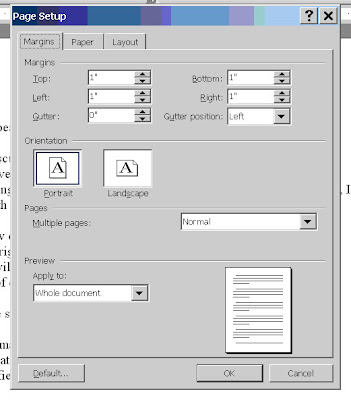
And the Winner Is ....
 The winner of an autographed cover picture of What's in a Name? is Ciara. Thanks for commenting on my post. Send me your snail mail address, and I'll get it out as soon as I can.And thanks to everyone for taking the time to leave a comment.
 (Shameless plug: What's in a Name? is still available for 99 cents. Details in the sidebar) And I'll announce the winner of yesterday's blog contest tomorrow, so there's still time to leave a comment and get entered in the drawing.Continuity in a book is a challenge. Continuity over a series is a bigger challenge. And when we forget, it can lead to facing reality. Our words aren't precious.
 One of my crit partners questioned a passage in a chapter, wondering if the child might be wondering about an adult conversation. Although the fix was simple—make sure I clarified that the child, Will, wasn't in that scene (which, I think my CP simply missed), as I re-read the passage I realized I'd created a major blunder.This manuscript deals with characters who have appeared in two other books—three if I get my next one published, but that's another issue. And because it's been a very long time since I looked at the earlier book, I'd totally forgotten that the child had already met this "new" character who was being introduced to him as a total stranger.Okay, on the optimistic hope that 1) this book gets published; 2) someone who reads it has actually read the others; and 3) remembers that Will and Dalton have appeared on the page together in the earlier book, I had to deal with it.
What I'm reading: Uncertain Magic, by Laura Kinsale (print)
Slow Hands, by Leslie Kelly (digital)Thanks to Jeffrey for his great post on finding ideas yesterday. I've given my take on Facebook and Twitter, so I figured a post about blogging might be next in line. But this time, I'd rather know what you want, like, and don't like. I blog because it's like chatting with friends, sharing information (and maybe the former schoolteacher in me comes out), and learning from others. What's in a Good Blog? – first my preferences, and my goals for this blog.Readability: Simple enough fonts, not a lot of bells and whistles, and for me, that means no dark background with white text. My eyes can't read that.Reliability: I have my list of stops on my blog hops, and if there's nothing new, I'm not likely to check back until my next trip. If you're going to blog, you need to commit to a schedule, even if it's only once or twice a week. I have posts 5 days a week, one of which is a guest slot, and one a "Field Trip" (and I'm still waiting for more pictures!)
Jeffrey A. Carver is the author of numerous science fiction novels and stories, including the Nebula-nominated Eternity's End, Battlestar Galactica: the Miniseries novelization, and the hard-SF series The Chaos Chronicles. Jeff also teaches writing in settings ranging from MIT to conferences for young writers, and he's dropped in today to talk about one of the thorniest challenges faced by many aspiring writers.New year! New ideas! Where do you get your ideas? That's the question most asked of every science fiction writer I know. It's a good question, I suppose, though the answer is simple: everywhere, everything I read, everyone I talk to, everything I see on the internet or watch on TV, everything that filters into my brain is a potential story idea. I'm up to my ears in ideas! The real question is, how do you turn an idea—which can be anything, even a simple concept or image—into a story, which is a sequence of events, one arising from another, in which believable characters grow and change?Here’s a simple idea that is not a story: The king dies, and the queen dies.
Yes, things happen, but there's no motivation cause or reason, nothing to care about. Here's that same idea, turned into the nucleus of a possible story: The king dies of a mortal wound, and the queen dies of sorrow. How much character, how much cause and effect, is embedded in that one sentence?
What I'm reading: The True Love Quilting Club, by Lori WildeToday, I thought I'd share the evolution of my new cover for What's in a Name? which is now available at Smashwords. As an introductory offer, you can get it for 99 cents by using coupon code XC48J. It's also available at the Kindle Store, also for 99 cents, but only for a limited time. I hope you'll give it a try.We all know you're not supposed to judge a book by its cover, but cover art can play an important role in getting a potential reader to check out the words inside. Normally, publishers provide covers. They'll ask for some preliminary input—with mine, there's a cover request form to fill out, but the art department makes the covers, not the author. They don't read the books (no time, obviously), so they have to translate what you give them to an image they think will sell. And that's the bottom line. What will sell the book? Often, it's not what the author 'sees' when she envisions the book on a shelf.Fast forward to the rights for a book reverting to the author. Those rights include the words between the covers, NOT the cover. For When Danger Calls, I did acquire the cover image rights, so that was easy. However, for What's in a Name?, I had to start from scratch.


